Frozen Evaporator Coil in Burbank
Fast take: Burbank Carrier HVAC diagnoses frozen Carrier evaporator coils across Burbank, CA - from the Media District (91523) to Burbank Hills - tracing the ice back to low airflow, a dirty filter or coil, or a low refrigerant charge; call (213) 277-7557 or book online. Switch the system to fan-only first to thaw it, then let us find the real cause.
By the numbers
- A frozen coil is an airflow or refrigerant problem, not a temperature one.
- Top causes: clogged filter, dirty coil, collapsed duct, weak blower, or low charge.
- Thaw with the fan on (compressor off) before any restart - 1 to 3 hours.
- Filter or coil cleaning: $80-$400; refrigerant leak repair plus recharge $225-$1,500.
- Running a frozen system risks compressor slugging - a $1,200-$3,500 failure.
- Service area 91501-91523; hours Mon-Sat 7am-7pm; emergency calls anytime.
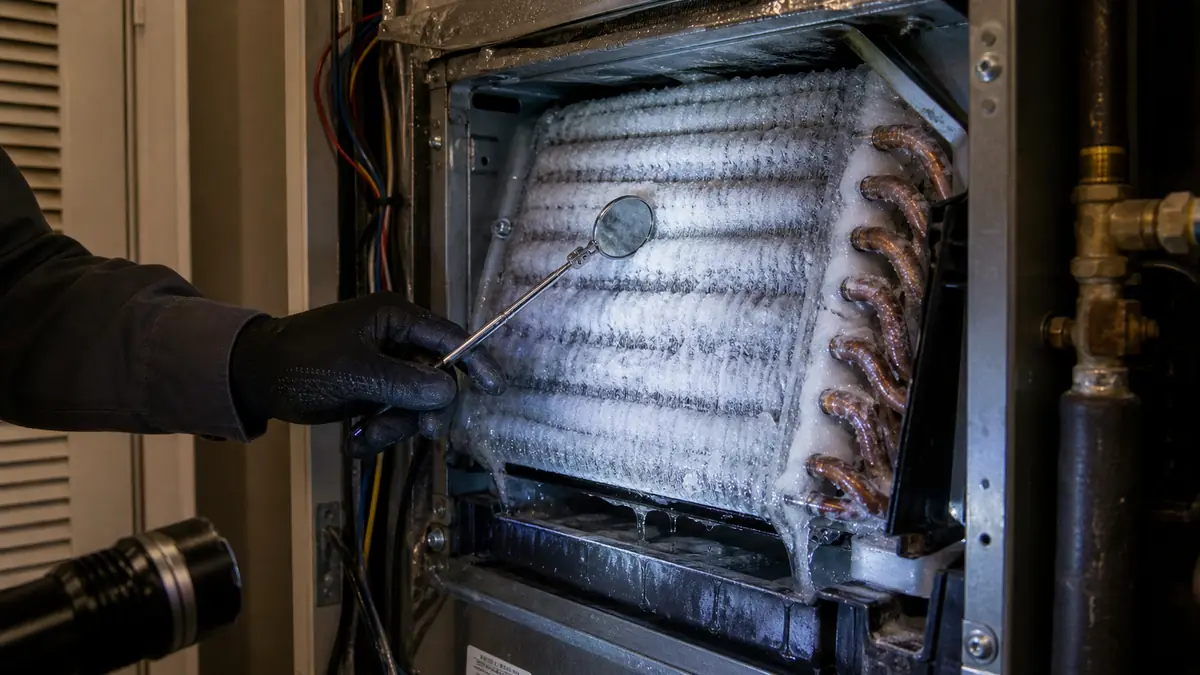
What freezes a Carrier evaporator coil?
The evaporator coil gets cold by design - that is how it pulls heat from your air. It only freezes when something starves it. Too little airflow (a clogged filter, a dirty coil, a crushed duct, or a failing ECM blower) means not enough warm room air crosses the coil to keep it above freezing. Too little refrigerant drops the coil pressure and temperature below the dew point. In Burbank's dry valley heat, a system running flat-out on a 95 F day with any of these problems ices over fast. The table sorts the causes by how we check them.
| Pattern | Likely cause / first check | Cost lane |
|---|---|---|
| Ice plus a filthy filter | Clogged filter starving airflow | $0-$80 (filter) |
| Ice, clean filter, dirty coil | Dirty evaporator coil | $150-$400 clean |
| Weak airflow at registers | Collapsed duct or weak ECM blower | $300-$2,300 |
| Ice plus weak cooling, hissing | Low refrigerant (leak) | $225-$1,500 |
| Code 44 on Infinity touchscreen | Air-delivery restriction | $150-$3,000 |
How do you diagnose it without just adding refrigerant?
By measuring airflow before touching the charge. We confirm the coil is fully thawed, then check the filter, inspect the coil face, and measure external static pressure to spot a duct or blower restriction. Only then do we connect gauges and read superheat and subcooling to judge the charge. If those numbers show a genuine undercharge, we leak-search - flare joints and the coil are common spots - repair the leak, and recharge to nameplate. Recharging over an airflow problem just refreezes the coil next week, so we refuse to do it.
What does a frozen coil cost to put right?
It depends entirely on what starved the coil, which is why we measure before we quote. The cheapest outcome is a clogged filter, often a $0-$80 swap you can do yourself. A dirty evaporator coil that needs a proper chemical clean runs about $150-$400. A weak or failed ECM blower, or a crushed return that has to be reworked, lands anywhere from $300 to $2,300 depending on the part. If the real fault is low refrigerant, the leak search plus repair and recharge sits in the $225-$1,500 band - flare joints and the coil itself are the usual leak points, and R-410A runs roughly $50-$80 a pound installed. The one expensive number to avoid is a compressor lost to repeated slugging, a $1,200-$3,500 replacement that a prompt diagnosis prevents.
Why thawing matters before we even arrive?
Two reasons. First, we cannot read static pressure or charge accurately on an iced coil, so a thawed system gets you a faster, cheaper diagnosis. Second, every minute you run a frozen system in cool mode risks slugging liquid refrigerant back to the compressor, the one part you cannot afford to lose. Switch to fan-only, let it melt, swap the filter, and we will pick up the real diagnosis from there. If it ices again right away, that confirms a deeper airflow or charge fault.
Common questions
Why is there ice on my Carrier AC when it is 95 F outside?
It sounds backwards, but a frozen coil is an airflow or refrigerant problem, not a cold-weather one. When too little warm air moves across the evaporator - from a clogged filter, a dirty coil, or a blower fault - or the charge is low, the coil surface drops below freezing and condensation turns to ice. The hotter it is outside, the harder the starved system tries, so it ices faster.
What should I do the moment I see ice?
Turn the cooling off but set the fan to on. Running the blower with the compressor off pushes room-temperature air over the coil and melts the ice in 1 to 3 hours. Do not run it in cool mode - that just builds more ice and can slug liquid refrigerant back to the compressor, risking expensive damage. Then change the filter and call for a charge and airflow check.
Does a frozen coil mean I am low on refrigerant?
Not always. Low refrigerant is one cause, but a dirty filter, a dirty coil, a collapsed duct, or a weak ECM blower starve airflow just as effectively. We do not assume a leak and recharge - we measure airflow and static pressure first, then gauge the charge and check superheat. Adding refrigerant to an airflow problem only masks it.
Can a frozen coil damage my Carrier compressor?
Yes, if you keep running it. When the coil ices over, liquid refrigerant that should have boiled off can return to the compressor - called slugging - and the compressor is built to pump vapor, not liquid. Repeated slugging wears or destroys it. That is why we stress thawing first and finding the root cause before restarting the system.
Related: short cycling (often the same root cause), duct repair, and Carrier AC repair.