Carrier AC Repair in Burbank
Fast take: Burbank Carrier HVAC repairs no-cool Carrier air conditioners across Burbank, CA - Magnolia Park, Burbank Hills, and the 91505 valley floor - starting with the dual-run capacitor, the contactor, and the refrigerant charge. Most repairs land in the $150-$450 band; call (213) 277-7557 or book online for same-week, often same-day, service.
By the numbers
- We service Carrier 26-series AC (Infinity 26VNA, Performance 26TPA/26SPA, Comfort 26SCA) plus older 24-series Greenspeed units.
- Most common Burbank summer failure: a blown dual-run capacitor, typically $150-$450 installed.
- Diagnostic fee: SoCal $89-$159, credited toward an approved repair.
- Refrigerant leak repair plus recharge: roughly $225-$1,500 depending on the leak location.
- Compressor replacement: $1,200-$3,500 out of warranty; lower if Carrier still covers the part.
- Service area: 91501, 91502, 91504, 91505, 91506, 91523; hours Mon-Sat 7am-7pm; emergency calls anytime.
- In-warranty sealed-system repairs go to Carrier's authorized dealer first to protect your coverage.
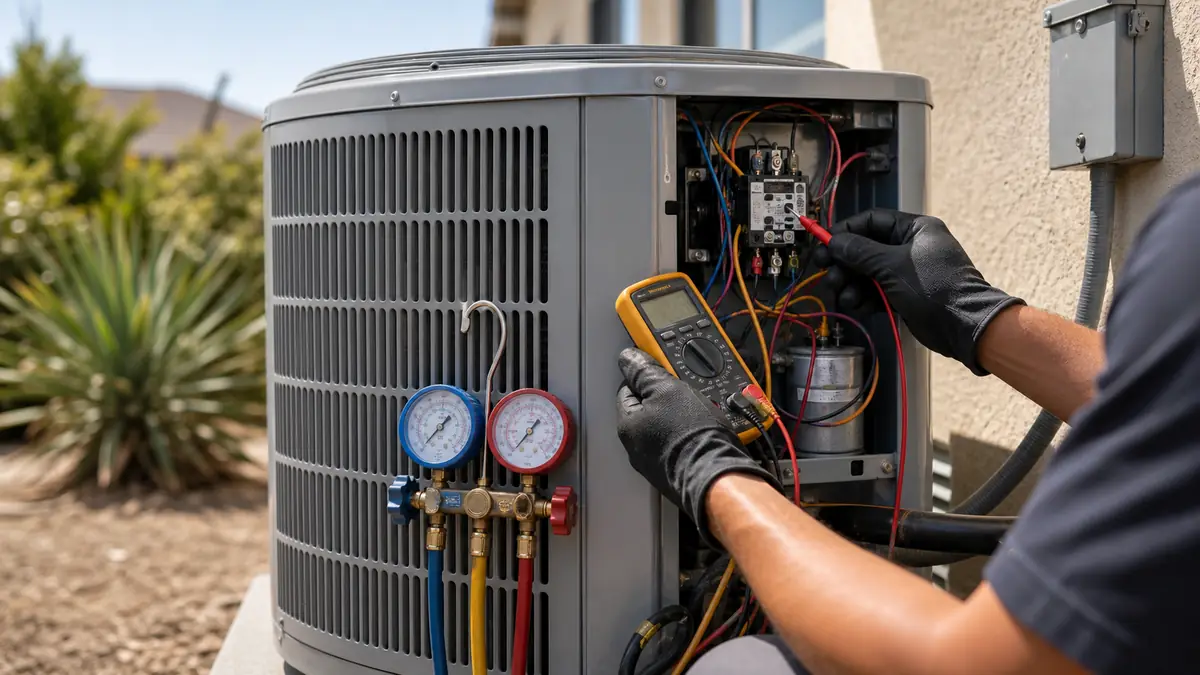
What usually breaks on a Carrier AC in Burbank?
On the southeast valley floor, where July highs sit around 90-95 F and the airport logs valley-record heat, the failures follow a pattern. Heat cooks the dual-run capacitor first - it is the cheapest part and the most common no-cool cause. Next come the contactor (whose points pit and weld from constant cycling) and the condenser fan motor. Refrigerant leaks at flare joints and the evaporator coil show up as weak, long-running cooling and sometimes a frozen coil. On Infinity Greenspeed systems, the inverter and communicating board add codes like 178 and 179 to the mix.
The table below is the diagnostic order we actually work, with the 2026 SoCal cost lane for each.
| Symptom | Likely cause / first check | Cost lane |
|---|---|---|
| Condenser hums, nothing spins | Failed dual-run capacitor; test contactor too | $150-$450 |
| Clicks on/off, no consistent cooling | Pitted/welded contactor or weak capacitor | $150-$450 |
| Runs constantly, cools weakly, coil ices | Low refrigerant (leak) or dirty coil/filter | $225-$1,500 |
| Outdoor fan dead, compressor hot | Condenser fan motor or its capacitor | $300-$900 |
| Infinity touchscreen shows 178/179 | A-B-C-D comm wiring or control board | $200-$2,000 |
| No cooling, breaker trips, compressor dead | Failed compressor (last resort diagnosis) | $1,200-$3,500 |
How do you diagnose a no-cool call, step by step?
We start at the disconnect and meter the system live: incoming voltage, capacitor microfarads against the nameplate, contactor pull-in, and compressor and fan amp draw. On a communicating Infinity unit, we pull the fault history off the System Control touchscreen first - codes like 73 (voltage at the run cap with no compressor call), 44 (airflow restriction), or 54/56 (sensor faults) point us straight at the problem. Only after the electrical side reads clean do we connect gauges and check the refrigerant charge and superheat, because chasing a "low on freon" theory on a unit that is really a bad capacitor wastes your money.
The sequence, in the order a tech actually works it:
- Confirm the call and read codes. Verify the thermostat is calling for cool and the contactor is being told to close; on an Infinity system, pull stored fault codes off the touchscreen.
- Meter the electrical side. Capacitor microfarads against the nameplate (a 45/5 uF dual-run cap reading 38 is failing), contactor coil pull-in and contact condition, and amp draw on the compressor and condenser fan with a clamp meter.
- Check airflow. Filter, blower, and coil cleanliness; a starved evaporator mimics a refrigerant problem and ices the coil.
- Gauge the refrigerant - last. Connect manifold gauges, read suction and liquid pressures, and calculate superheat and subcooling against the nameplate charge before declaring a leak.
- Quote, repair, verify. Written number first, then the fix, then re-check temperature split across the coil (a healthy system pulls roughly 16-22 F) and confirm no codes return.
Which Carrier AC lines do you repair in Burbank?
We work the full current and recent Carrier lineup, and the failure pattern shifts by tier. Value single-stage units (Comfort 26SCA5, 26SCA4) are simple 24V systems - capacitor, contactor, fan motor, charge. Mid-tier Performance adds staging: the two-stage 26TPA8 has a low and high stage that can fail at the thermostat wiring, while the single-stage 26SPA6 behaves like a Comfort unit. The premium Infinity Greenspeed line (24VNA6 Infinity 26, 26VNA1 Infinity 21, and the recent 25VNA4 heat-pump flagship) runs a variable-speed inverter compressor over the ABCD communicating bus, so its faults skew toward 178/179 communication codes and inverter-board issues rather than a simple blown capacitor. Knowing which line is on the pad tells us where to look first.
What does Carrier AC repair cost in Burbank, and why?
The headline band is wide because the jobs are different animals. Here is how it breaks down and what drives each number:
- Diagnostic ($89-$159): the metered finding and written quote, credited toward an approved repair. This is the trip and the time, not the part.
- Capacitor or contactor ($150-$450): the part is cheap ($10-$45); the cost is labor and the trip. These are the most common Burbank summer fixes and almost always same-visit.
- Condenser fan motor ($300-$900): part cost plus matching the motor and capacitor to the unit.
- Refrigerant leak repair plus recharge ($225-$1,500): leak search runs $100-$330; R-410A is roughly $50-$80 per pound installed; a flare or Schrader fix is cheap, a coil leak is not.
- Compressor ($1,200-$3,500 out of warranty): the big-ticket sealed-system repair, where the repair-or-replace math usually tips toward replacement on an older unit.
These are approximate 2026 SoCal ranges; the written quote on your visit is the real number.
What about a Carrier AC still under warranty?
Carrier's standard residential warranty typically covers parts (often 10 years with registration), and the sealed system - compressor and coil - is the expensive part. If your unit is in that window, your first call should be Carrier's authorized dealer so the warranty claim stays valid. Where we add value is everything outside that: out-of-warranty repairs, capacitor and contactor failures (rarely covered anyway), second opinions on a quote you do not trust, and full installs. We will tell you honestly which door saves you the most.
Why does Burbank's climate wear AC out faster?
The Santa Monica Mountains and the valley geometry trap heat against the floor, and Burbank's airport-zone microclimate runs hotter than the LA coast by roughly 10 F on summer afternoons. A system sized for a mild climate gets run hard here, so capacitors, contactors, and compressors all see more thermal stress. Add a 1930s bungalow with leaky ducts or an oversized condenser that short-cycles, and components fail years early. Fixing the airflow and sizing - not just swapping the failed part - is what makes the repair stick.
Common questions
Why does my Carrier AC hum but the fan and compressor stay dead?
That signature - a humming condenser with nothing spinning - is almost always a failed dual-run capacitor, the single most common Carrier AC failure in Burbank summer heat. The capacitor stores the jolt the motors need to start. Replacement runs $150-$450; we test the contactor at the same time since the two often fail together.
How long does a typical AC repair take?
Most electrical repairs - capacitor, contactor, condenser fan motor - are done within the same visit, usually under an hour once diagnosed. Refrigerant leak searches and recharges take longer, and a compressor or coil job may need a return trip for parts. We give you the time estimate with the written quote.
Is it worth repairing a 14-year-old Carrier condenser?
It depends on the part and the price. A $250 capacitor on a 14-year-old 26SCA5 is still worth it; a $2,000-plus compressor or coil on the same unit usually is not, because you are spending half a replacement on aging equipment that no longer meets SEER2. We will run the repair-or-replace math before you commit.
Do you recharge refrigerant without finding the leak?
No. Topping off R-410A without fixing the leak just vents refrigerant into the air and bills you again next summer. We pressure-test, find the leak - flare joints, the coil, or a Schrader core are common spots - repair it, then recharge to the nameplate. That is both the legal and the lasting fix.
What does a 73 code on my Infinity touchscreen mean during a no-cool?
Code 73 means the control sensed voltage at the run capacitor when there was no call for the compressor - a wiring, contactor, or relay context on 24ANA and 25HNA-type outdoor families. It points us at the electrical side, not the sealed system. We trace the contactor and run-cap wiring before condemning any board or compressor.
Why does my AC freeze into a block of ice when it is 95 F outside?
A frozen evaporator coil on a hot day almost always means restricted airflow or low refrigerant. A clogged filter, a dirty coil, or a weak blower starves the coil and drops it below freezing; a refrigerant leak does the same from the other direction. We thaw it, then find the root cause - see our frozen-coil page for the full diagnostic walkthrough.
Related: Carrier AC installation, frozen evaporator coil, AC short cycling, Carrier Performance series, and the repair-or-replace guide.