Repair or Replace Your Carrier AC in Burbank
Fast take: Repair or replace your Carrier AC in Burbank? Burbank Carrier HVAC works a plain rule for Burbank, CA homes: once a repair runs past half the cost of a new system and the unit has crossed 10 to 12 years, replacing it is the call. We do the arithmetic against real 2026 SoCal bands. Call (213) 277-7557 or book online for a straight second opinion.
By the numbers
- Swap-it test: the repair exceeds ~50 percent of a new system AND the unit is past 10-12 years.
- The $5,000 test: when age multiplied by repair cost clears $5,000, lean toward replacing.
- Central AC replacement in SoCal: $5,000-$12,000; premium Greenspeed higher.
- Compressor replacement: $1,200-$3,500 out of warranty - often the tipping point.
- Most Carrier systems last 12-18 years; Burbank heat pushes toward the low end.
- Fresh installs have to hit 14.3 SEER2 plus Title-24 charge/airflow verification.
- Service area 91501-91523; hours Mon-Sat 7am-7pm; emergency calls anytime.
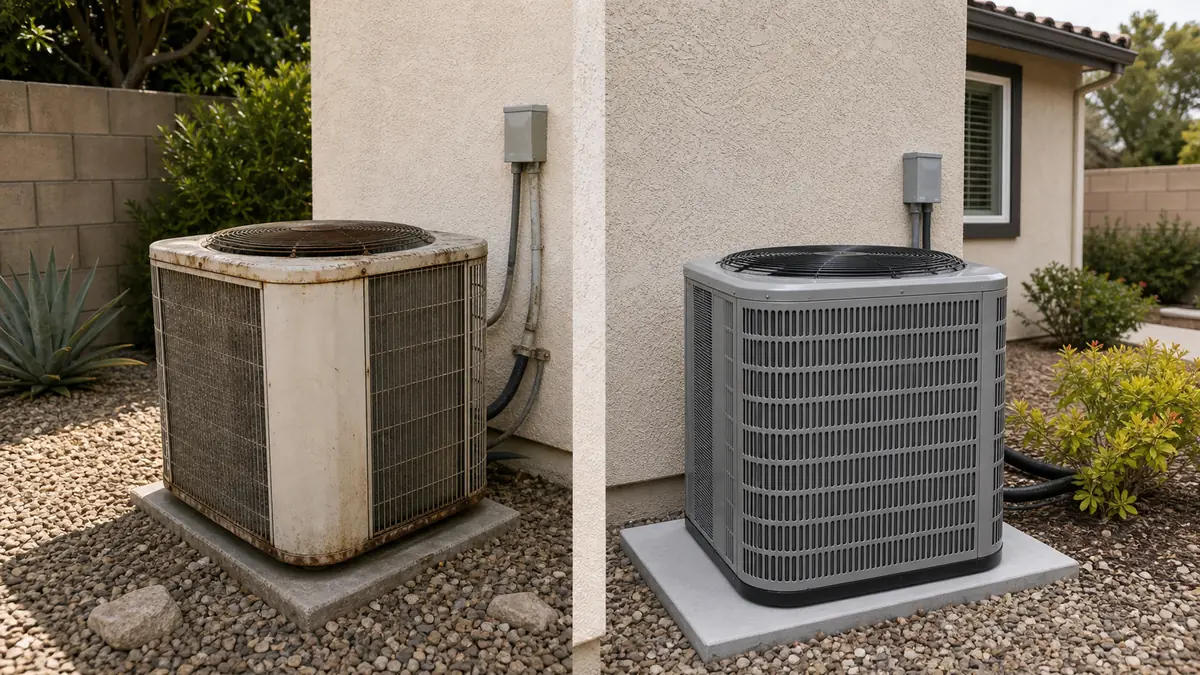
How do you decide repair or replace?
Two figures carry the decision on a Burbank condenser: the unit's age and what today's repair would cost. Our working threshold is simple - if that quote climbs above roughly half what a fresh system costs and the equipment is already on the far side of 10 to 12 years, a replacement is the smarter Burbank spend. A second check backs it up: multiply the unit's age by the repair quote, and a result over $5,000 flags the aging-condenser cases where even a moderate repair stops penciling out. Dropping a $250 capacitor into an 8-year-old 26SPA6 is a no-brainer; sinking $2,500 into a compressor on a 16-year-old condenser almost never is.
Beyond the formula, three Burbank-specific factors tilt the call: the valley-floor heat that shortens equipment life, the SEER2 efficiency you gain on a new system, and whether the old unit was oversized to begin with (in which case replacement is also a chance to right-size). The table below shows how the decision usually breaks down by age and repair size.
| Unit age | Small repair (under $500) | Large repair ($1,500+) |
|---|---|---|
| Under 8 years | Repair - clear choice | Repair if not the compressor |
| 8-12 years | Repair, plan ahead | Get a replacement quote too |
| 12-16 years | Repair only if minor | Replace - usually |
| Over 16 years | Weigh replacement | Replace |
Three worked Burbank examples
The rules are easier to trust once you run them on real situations. Each case below uses the two tests - the 50-percent rule and the age-times-cost ($5,000) rule - against 2026 SoCal bands. Treat the dollar figures as planning numbers; the actual call always follows a written diagnosis.
Case 1 - the easy repair. An 8-year-old Carrier Performance 16 (26SPA6) on a Chandler Park ranch home hums but will not start on a 96 F afternoon. The diagnosis is a failed dual-run capacitor, a $150-$450 fix. Run the math: $300 is nowhere near half a $7,000 replacement, and age times repair (8 x $300 = $2,400) sits well under $5,000. Both tests say repair, and it is not close - this unit has years of service left.
Case 2 - the genuine fork. A 13-year-old Comfort 16 condenser in Magnolia Park needs a compressor, quoted at $2,600 out of warranty. The 50-percent test: $2,600 against a roughly $6,500 replacement is about 40 percent - borderline. The age test: 13 x $2,600 = $33,800, far past $5,000 - a loud replace signal. Add the valley-floor heat that already aged this unit hard and the SEER2 efficiency you would gain, and replacement is the smarter spend even though the repair is technically possible.
Case 3 - replace without debate. A 17-year-old condenser in Burbank Hills has a leaking evaporator coil and a tired R-410A circuit, with a leak repair plus recharge quoted near $1,400 and a hint the compressor is on its way out. Both tests scream replace, and the refrigerant phase-down only sharpens it - pouring money into an aging R-410A system to keep it limping is the classic good-money-after-bad trap.
| Case | Repair quote | 50% test | Age x cost test | Verdict |
|---|---|---|---|---|
| 8-yr 26SPA6, capacitor | ~$300 | Far under half | $2,400 (under $5k) | Repair |
| 13-yr Comfort 16, compressor | ~$2,600 | ~40% (borderline) | $33,800 (over $5k) | Replace |
| 17-yr unit, coil leak | ~$1,400 | High on old unit | $23,800 (over $5k) | Replace |
What do repairs and replacements actually cost here?
Concrete numbers make the decision easier. The bands below are blended 2026 Southern California ranges - SoCal labor and permitting run above the national average, and premium communicating or variable-speed parts skew toward the high end. Treat them as planning figures and confirm with a written quote, which we provide before any work.
| Job | Typical cost | Notes |
|---|---|---|
| Diagnostic / service call | $89-$159 | Credited toward an approved repair |
| Capacitor or contactor | $150-$450 | Most common, almost always worth it |
| Refrigerant leak + recharge | $225-$1,500 | Major leak favors replacement on old units |
| ECM blower motor | $450-$2,300 | Variable-speed at the high end |
| Compressor | $1,200-$3,500 | The usual replace-instead tipping point |
| Central AC replacement | $5,000-$12,000 | Comfort low, Infinity Greenspeed high |
| Ducted heat-pump install | $6,000-$16,000 | Gas-to-electric; check utility rebates |
Does Burbank's climate change the calculus?
It does. A system here runs hard through 40 to 55 days a year above 90 F, with the airport zone logging valley-record heat. That accelerates wear on compressors, capacitors, and coils, so a Burbank unit tends to reach the replace-worthy stage a year or two earlier than the same model on the coast. The flip side: because you run cooling so much, the efficiency jump from an old 10-13 SEER unit to a modern 15-plus SEER2 Carrier system shows up on your summer bills faster than it would in a mild market - which strengthens the replacement case once a unit is genuinely old.
Which specific failures usually tip toward replacement?
Not every repair carries the same weight in the decision. Some are cheap, routine, and never argue for replacement; others are expensive enough or signal enough underlying wear that they shift an aging unit over the line. The list below sorts the common Carrier failures by how much they should move your thinking on a 12-plus-year-old system.
| Failure | Typical cost | Weight on the decision |
|---|---|---|
| Dual-run capacitor or contactor | $150-$450 | Low - almost always repair |
| Condenser fan motor | $300-$700 | Low to moderate |
| ECM blower motor / module | $450-$2,300 | Moderate on an old unit |
| Refrigerant leak + recharge (R-410A) | $225-$1,500 | High - phase-down compounds it |
| Infinity / inverter control board | $400-$2,000 | High on a 12-plus-year system |
| Compressor (out of warranty) | $1,200-$3,500 | Very high - usual tipping point |
The pattern is clear: a sealed-system failure - compressor or coil leak - is the one that most often pushes an older Burbank unit toward replacement, both because the part is costly and because it tends to travel with other end-of-life wear. A capacitor or contactor, by contrast, is a same-visit fix that keeps a sound unit running for years.
Does the R-410A refrigerant phase-down change the math?
It does, quietly but steadily. The industry has moved new equipment toward lower-GWP refrigerants, and R-410A - the refrigerant in most Burbank systems installed over the last 15 years - is being phased down. As supply tightens, the cost to recharge an older leaking system trends up and gets less convenient over time. For a unit already past 12 years with a refrigerant leak, that is one more reason a recharge is a stopgap rather than a fix: you are buying increasingly pricey refrigerant for a circuit that will likely leak again. A new system on a current-generation refrigerant sidesteps the whole problem. We factor refrigerant type into the written recommendation so the phase-down does not blindside you a year or two down the line.
If you replace, what should you avoid?
The number-one error is matching the old tonnage one for one. That dead unit was frequently oversized to begin with, and an outsized new condenser will short cycle, leave humidity in the air, and burn out early - all the more so in Burbank's compact pre-war footprints. Hold out for a Manual J load calculation instead of a rule of thumb. Error number two is bolting a high-efficiency variable-speed system onto leaky, undersized ducts, since the SEER2 rating counts on ductwork that can actually move the airflow. Walk through our sizing guide and weigh duct sealing as part of any replacement.
What does Burbank's heat do to system lifespan?
It compresses the timeline. Most Carrier central systems are rated for 12 to 18 years, but lifespan is a function of run hours, and Burbank's valley-floor location near Hollywood Burbank Airport delivers 40 to 55 days a year at or above 90 F - among the heaviest cooling loads in the San Fernando Valley. A condenser that might coast to 18 years on the coast often lands closer to 12 to 14 here, because every one of those 95 F afternoons keeps the compressor and capacitor working at the top of their range. That shorter clock matters for the decision in two ways. First, a Burbank unit reaches the replace-worthy zone a year or two earlier than the same model elsewhere, so do not be surprised when a 13-year-old system is genuinely near end of life. Second, because you run cooling so heavily, the efficiency gain from a modern high-SEER2 system pays back faster here than in a mild market - which strengthens the replacement case the moment a unit is truly old. The flip side is that a right-sized, maintained system with annual capacitor and charge checks can still reach the upper end of the range, so neglect is what most often forces an early swap.
What about warranty before you spend anything?
Check the registration. Carrier's standard parts warranty is often 10 years with registration, and the sealed system - compressor and coil - is the expensive part. If a major failure hits inside that window, your first call is Carrier's authorized dealer so the claim stays valid; replacing the part yourself or through a non-authorized shop can void coverage. We will tell you honestly when warranty makes repair the obvious choice, and we handle everything once a unit is out of warranty.
Common questions
What is the simple rule for repair versus replace?
Lean on two rough tests. The first: when a repair runs past roughly 50 percent of a new system's price and the unit has already passed the 10-to-12-year mark, swap it out. The second: take the unit's age, multiply it by the repair quote, and if the product clears $5,000, replacing usually wins. Neither is a hard law, but used together they stop you from sinking cash into worn-out equipment.
How long does a Carrier AC last in Burbank's heat?
Most central systems run 12 to 18 years, but Burbank's valley-floor heat - 40 to 55 days a year over 90 F - works equipment harder than a coastal climate, so units here often land at the lower end. An oversized or neglected system fails sooner; a right-sized, maintained one lasts longer.
Does R-410A being phased down change my decision?
It is a factor. The industry has shifted new equipment toward lower-GWP refrigerants, and R-410A is being phased down, which can make refrigerant for older systems pricier and less convenient over time. A major leak repair on an aging R-410A unit is a point in favor of replacing rather than recharging year after year.
Will I have to upgrade to meet code if I replace?
Probably a little. Any new split system going into Burbank has to clear the Southwest-region floor of 14.3 SEER2, and Title-24 generally brings on refrigerant-charge and airflow verification, with duct-leakage testing added once you open the ducts. None of that is unusual on a code-compliant swap - we write it into the quote so nothing blindsides you.
Last updated 2026-06-13.
Related: HVAC sizing and Manual J, SEER2 and rebates, and Carrier AC repair.