Duct Repair & Sealing in Burbank
Fast take: Burbank Carrier HVAC seals, resizes, and replaces ductwork across Burbank, CA - the 1920s-1940s cottages of Magnolia Park and Chandler Park (91506) especially - so a Carrier system delivers its rated capacity. Work runs $1,900-$6,000 with Title-24 HERS verification built in; call (213) 277-7557 or book online.
By the numbers
- Service area: all Burbank ZIPs 91501, 91502, 91504, 91505, 91506, 91523.
- Duct repair and replacement typically runs $1,900-$6,000 depending on home size and access.
- Leaky attic ducts can waste 20-30 percent of a system's cooling in valley heat.
- For alterations in Climate Zone 9, Title-24 routinely calls for duct-leakage testing under HERS verification.
- We pair duct work with Carrier 59/58-series furnaces and 26-series condensers, or compact 37M ductless systems.
- Hours: Mon-Sat 7am-7pm; emergency calls anytime.
Why do Burbank ducts cause so many comfort complaints?
The housing stock is the story. Much of Burbank predates central air, so ducts were added later into shallow attics and tight crawlspaces - often undersized, taped with cloth that has long since dried out, and run too far for the blower to push against. In a vented attic that bakes well past 110 F on a 95 F Burbank day, every leak in the supply side dumps cold air where nobody lives. The result is a Carrier condenser that runs and runs while the back bedroom never cools.
Here is how we triage duct issues and where the cost lands.
| Symptom | Likely cause / first check | Cost lane |
|---|---|---|
| One room never cools | Crushed, disconnected, or undersized run | $300-$1,500 spot repair |
| High bills, long runtimes | Supply leakage into the attic | $1,000-$3,000 seal |
| Weak airflow at every register | Undersized trunk or high static pressure | $2,000-$6,000 resize |
| Dusty air, musty smell | Return leaks pulling attic/crawlspace air | $800-$2,500 |
| New condenser, same hot rooms | Ducts never matched the equipment | $1,900-$6,000 replace |
| Whistling or roaring registers | High static pressure, undersized return | $400-$2,000 |
How does a duct-sealing job actually go?
Duct work is diagnostic before it is repair. We do not just wrap tape and hope - we measure, fix, then prove the result with numbers.
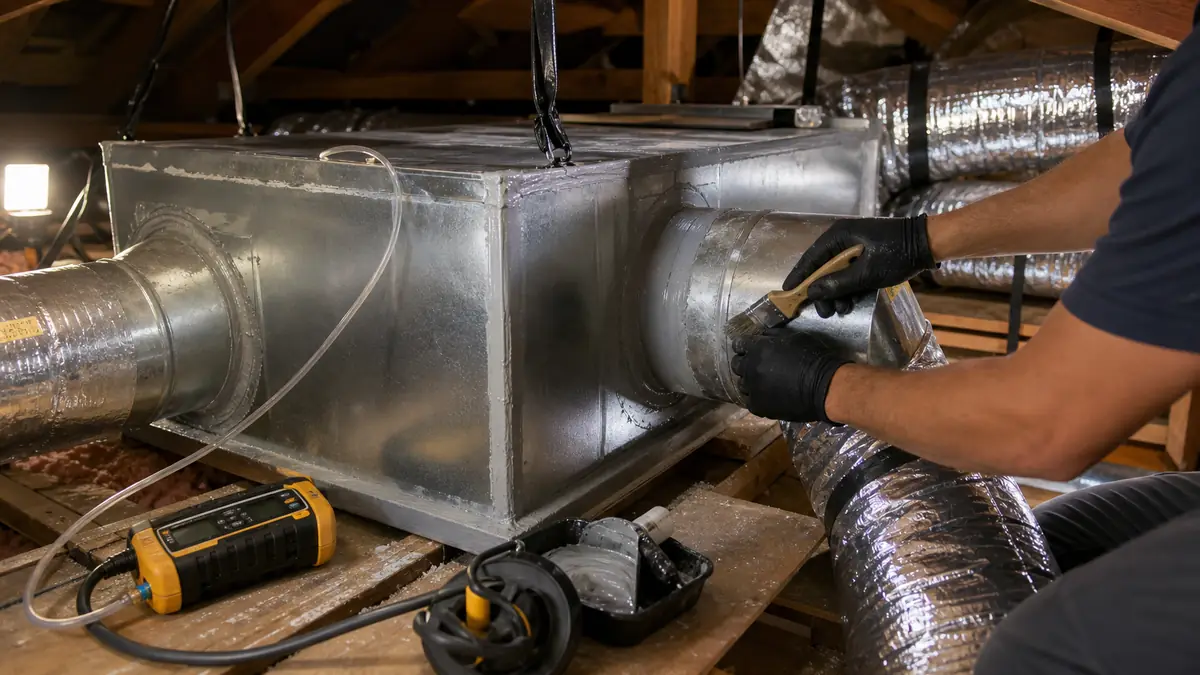
- Static-pressure test. A manometer at the supply and return plenums reads total external static pressure; a 1930s system pushing well past 0.8 in. w.c. is fighting undersized or leaky ducts and the blower is straining.
- Room-by-room airflow. We measure delivery at each register to find the starved run - usually the longest one to a back bedroom in a bungalow.
- Find the leaks. Visual inspection plus, where the scope triggers it, a duct-leakage (blower-style) test that quantifies how much conditioned air is escaping into the attic.
- Seal with mastic, not cloth tape. Brush-grade mastic and mesh at every joint, boot, and plenum connection; cloth duct tape dries out and is exactly what failed in these homes the first time.
- Resize or replace where needed. A crushed or undersized trunk gets replaced rather than patched, so the airflow matches the Carrier equipment.
- HERS verification. On qualifying Climate Zone 9 jobs, an independent HERS rater field-verifies the leakage rate, and you get the documented number on paper.
What does duct work cost in Burbank, and why?
The $1,900-$6,000 band splits by scope and access:
- Spot repair ($300-$1,500): reconnecting or replacing one crushed or disconnected run to fix a single hot room.
- Whole-system seal ($1,000-$3,000): mastic at every joint, boot, and plenum, plus return-leak repair - the highest return on a leaky pre-war system.
- Resize a trunk or return ($2,000-$6,000): correcting undersized ductwork so a variable-speed Carrier system can move its rated airflow at the right static pressure.
- Full replacement ($1,900-$6,000+): new duct system, driven up by attic access, home size, and complex runs in a slab or shallow-attic cottage.
- HERS verification: the independent rater fee folds into qualifying jobs; we flag it up front so it is never a surprise.
These are approximate 2026 SoCal ranges. Access is the wildcard - a crawlspace-only 1930s cottage costs more to work in than an open attic.
How does duct work tie into a Carrier install?
A variable-speed Carrier system - a Greenspeed 24VNA6 condenser or a 59MN7 modulating furnace with a variable-speed ECM blower - only delivers its quiet, even comfort if the ducts can carry the airflow at the external static pressure the SEER2 rating assumes. Drop a high-efficiency system onto leaky, undersized 1950s ducts and you get noise, short cycling, and an efficiency number you never actually see. That is why we test static pressure and seal or resize the ducts as part of any replacement, not as an upsell afterward.
What does Title-24 require in Burbank?
Burbank falls inside Title-24 Climate Zone 9, where California's energy code generally demands duct-leakage testing with independent HERS field verification any time you alter or replace ductwork or put in a new split system. We line up that verification so the job passes and the measured leakage rate is documented. And we flag up front whether your particular scope sets off testing - some minor repairs do not - so no inspection cost catches you off guard.
The housing stock decides how often this comes up. A Magnolia Park or Chandler Park cottage with a shallow attic and a slab floor frequently has no clean place to add or resize ductwork, which is when a compact ducted Carrier air handler with short runs, or a 37M ductless system, becomes the practical path - and the duct-alteration trigger changes with it. We assess attic clearance, chase space, and the floor type before recommending a scope, so the Title-24 picture is clear before any work or testing is scheduled.
Common questions
Why is one room in my Burbank bungalow always hot?
In 1920s-1940s cottages it is usually a duct problem, not the AC: a long, crushed, or disconnected run starving that room, or ducts so leaky that conditioned air dumps into the attic before it reaches the register. We map static pressure and airflow room by room, then seal or resize the offending run rather than oversizing the condenser.
Does duct sealing in California need an inspection?
Frequently, yes. Title-24 treats most duct alterations or replacements in Climate Zone 9 as a trigger for duct-leakage testing, verified in the field by an independent HERS rater. We fold that into the job so the work stays code-compliant and the leakage figure is on paper - which matters if the home ever goes on the market.
Can you add ducts to a house that never had central air?
Sometimes, but it is invasive in a slab or shallow-attic bungalow. Often the smarter Burbank answer is a compact ducted Carrier air handler with short runs, or a 37M ductless system, which avoids tearing into plaster walls. We assess attic clearance and chase space before recommending a path.
Will sealing my ducts actually lower my bill?
Typically, yes. Leaky ducts in a vented attic that hits 120 F-plus in a Burbank summer can lose 20-30 percent of the cooling you paid for. Sealing those leaks lets a correctly-sized Carrier system reach the temperature set point faster and cycle less, which cuts runtime and wear.
What is high static pressure, and why does it matter?
Static pressure is the resistance your blower fights to push air through the ducts. Undersized or leaky runs drive it high - past about 0.8 in. w.c. on many older Burbank systems - which starves airflow, ices coils, and burns out blowers. A variable-speed Carrier ECM blower is rated at a specific static pressure; exceed it and you never see the SEER2 you paid for.
Do leaky ducts affect air quality, not just bills?
Yes. Return-side leaks in an attic or crawlspace pull in dust, insulation fibers, and humid or musty air, then push it through the house. In a 1930s Burbank cottage with an unsealed return, that shows up as dusty surfaces and a stale smell. Sealing the return both improves the air and stops the system pulling 120 F attic air it then has to cool.
Related: HVAC sizing and Manual J, Carrier AC repair, and frozen coil diagnosis (low airflow is a common cause).