Emergency AC Repair in Burbank
Fast take: Burbank Carrier HVAC runs same-day emergency no-cool calls across Burbank, CA - Burbank Hills (91504) to the Media District - carrying the capacitors and contactors that fail most in valley heat. The common after-hours fix lands at $150-$450; call (213) 277-7557 or book online and we triage urgent calls first.
By the numbers
- Same-day priority for total no-cool calls during 90 F-plus weather.
- Truck-stocked parts: dual-run capacitors, contactors, fan motors, igniters, flame sensors.
- Typical after-hours repair: $150-$450 for the common capacitor/contactor fix.
- Service area: all Burbank ZIPs 91501, 91502, 91504, 91505, 91506, 91523.
- Hours: Mon-Sat 7am-7pm; emergency calls anytime - emergency calls answered anytime.
- Read your Infinity fault code to us and we often arrive with the part in hand.
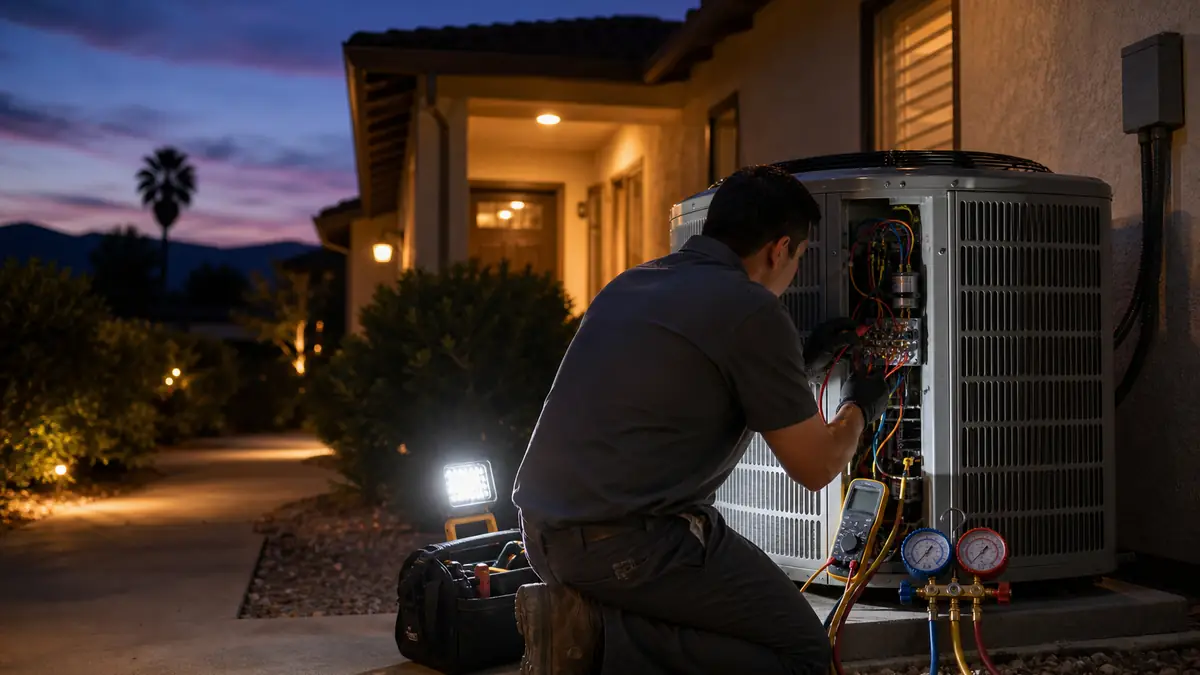
What breaks during a Burbank heat wave?
When a Santa Ana event or a midsummer ridge parks over the San Fernando Valley and Hollywood Burbank Airport logs valley-record highs, AC systems run flat-out for days. The dual-run capacitor is the first casualty - heat-stressed and asked to start the compressor over and over. The contactor pits and welds; the condenser fan motor overheats; a marginal charge finally shows as a frozen coil. None of these are exotic. They are the same handful of parts failing under load, which is why we carry them and can usually fix them in one visit.
| Symptom | Likely cause | Same-day fix? |
|---|---|---|
| Hums, nothing runs | Failed dual-run capacitor | Yes - stocked |
| Clicks, then stops | Pitted/welded contactor | Yes - stocked |
| Compressor runs, fan dead | Condenser fan motor | Usually |
| Cools weakly, coil iced | Low charge / frozen coil | Often (thaw + leak check) |
| Breaker keeps tripping | Shorted compressor or wiring | Diagnose first |
Why do Burbank heat waves cluster the emergency calls?
The calls arrive in a wave because every aging system on the valley floor hits its limit inside the same 48 hours, so a two-tech shop can field a week's worth of no-cool in two days. The systems most at risk were already marginal before the spike: a capacitor reading 38 microfarads on a 45 uF nameplate, an oversized 4-ton condenser short-cycling a small cottage, or a leaky pre-war duct run that never let the unit catch up to setpoint. Because the failures cluster on the same handful of parts, we stock them deep going into a forecast heat event and route emergency dispatch by who is most at risk - infants, elderly, and medical-need households - rather than strictly first-come.
What should I do before you arrive?
Turn the thermostat to off and the system to fan-only to keep air moving without forcing a failing compressor. If the coil is iced, switching to fan-only helps it thaw before we get there. Pull the filter and check it - a clogged filter starves airflow and can mimic a refrigerant problem. On an Infinity system, photograph the fault code on the touchscreen. Then close blinds on the sun side; a 1930s bungalow with single-pane windows heats fast on a 95 F afternoon.
How does an emergency call run once you arrive?
Speed comes from a tight sequence, not from skipping steps. The order on a no-cool emergency:
- Triage on the phone. Indoor temperature, who is home (infants, elderly, medical conditions), and any fault code on the Infinity touchscreen - we often know the likely part before we roll.
- Confirm the failure fast. At the disconnect: capacitor microfarads, contactor pull-in, and compressor and fan amp draw. A humming condenser with nothing spinning is almost always a blown dual-run capacitor.
- Fix from the truck. Capacitors, contactors, fan motors, igniters, and flame sensors ride on the van, so the common heat-wave failures are a same-visit repair.
- Quote before installing. The after-hours diagnostic is quoted before we roll; the repair price is confirmed in writing on-site - no surprise line items.
- Verify and stabilize. Re-check the temperature split and amp draw, confirm no codes return, and if the fix needs a return-trip part, we get you cooling on a window unit or fan-only so nobody is stranded in dangerous heat overnight.
What can you fix same-day versus a return trip?
Most heat-wave emergencies are the same handful of parts, and we stock them. What is realistic on the first visit, and what is not:
- Same-visit (stocked): dual-run capacitor, contactor, condenser fan motor, hot-surface igniter, and flame sensor - the failures that account for the bulk of Burbank no-cool and no-heat calls.
- Often same-visit: a frozen coil from low airflow (thaw, clean, recharge if a minor leak) and a clogged condensate float shutdown.
- Usually a return trip: a failed Greenspeed inverter or communicating board, a compressor, or a coil leak - parts that are ordered to the specific Carrier model (26VNA1, 24VNA6, 27VNA3).
When it is a return-trip part, we prioritize getting you safe and partially cooling before we leave.
What does an after-hours call cost in Burbank?
After-hours and weekend rates run above a scheduled weekday visit - standard across SoCal. The common capacitor or contactor fix lands at $150-$450 including the after-hours premium; a fan motor runs $300-$900; a refrigerant or coil issue runs higher. We quote the after-hours diagnostic before we roll and confirm the repair price in writing on-site, so the number is set before any part goes in. These are approximate 2026 SoCal ranges.
When is it not really an emergency?
Honesty saves you money. If the system still cools but is weak, or it is a mild 80 F day, a scheduled next-day visit at standard rates is cheaper than an after-hours call - and we will tell you so. We reserve emergency dispatch for genuine no-cool in dangerous heat, no-heat in a cold snap, electrical-burning smells, and water or safety shutdowns. For everything else, see our standard AC repair page.
Common questions
What counts as an HVAC emergency in Burbank?
A total no-cool when outdoor temperatures are in the 90s or higher and the indoor temperature is climbing past safe levels - especially with infants, elderly residents, or someone with a health condition at home. A burning smell, repeated breaker trips, or a furnace lockout in cold weather also qualify. Call and describe it; we triage by urgency.
Can you really fix it same day, or just look at it?
Most heat-wave emergencies are a blown dual-run capacitor or a pitted contactor - parts we stock on the truck - so a real same-visit repair is realistic. Compressor, coil, or board failures may need a return trip for parts, but we can often get you limping or get a window unit conversation started so you are not stranded overnight.
Do you charge extra for after-hours calls?
After-hours and weekend emergency rates run higher than a scheduled weekday visit - that is standard across SoCal. We quote the after-hours diagnostic before we roll, and the repair price is confirmed in writing on-site. No surprise line items once we are there.
My Carrier shows a fault code during the emergency - does that help?
A lot. If you read us the Infinity touchscreen code - 178 or 179 comm fault, 44 airflow, 73 at the run cap, or a furnace 13/14/31 lockout - we often know the likely part before we arrive and can carry it. Snap a photo of the screen while you wait for us.
It is 100 F and my AC is dead - how do I stay safe until you arrive?
Move to the coolest room, close blinds on the sun side, run fans, and hydrate - a 1930s Burbank bungalow with single-pane windows heats fast. Switch the system to fan-only to keep air moving and let an iced coil thaw. If anyone shows heat-illness signs, do not wait on us; call emergency services. We triage households with infants, elderly, or medical needs first.
Do you handle no-heat emergencies, not just no-cool?
Yes. A furnace lockout in a cold snap is an emergency, especially for vulnerable households. We carry hot-surface igniters and flame sensors, the two most common no-heat parts on Carrier 59 and 58-series furnaces, and we read the lockout code - 13, 14, 31, or 34 - to target the fix. A burning smell or repeated breaker trips also warrant an immediate call.
Related: frozen evaporator coil, short cycling, and standard Carrier AC repair.